| MLK Jr. during the Bus Boycott |
| The March on Washington |
| Martin Luther King Jr. |
| MLK Jr. during the Bus Boycott |
| The March on Washington |
| Martin Luther King Jr. |
| Regents v. Bakke |
| David Duke |
| Ron Stallworth |
| Brunswick Academy |
During the Civil Rights Era of the United States, the country was divided again between the supports and opponents of the movement. As the nation was approaching a century since the end of the civil war, the remnants of the old south were still present. While the northern states were the most progressive, many areas in the southern states were still stuck in time. The civil rights movement had a lot of opposition, especially from the Ku Klux Klan. Throughout the extent of the American Civil Rights Era, the Klan and other white supremacy groups committed horrific events against the African American community and its supporters.
One of the worst displays of violence by the Klan was the 16th Street Baptist Street Church Bombing in 1963. In Birmingham, Alabama on September 15th, four members of the Ku Klux Klan detonated a bomb that had been planted under the steps of the church. The bomb detonated around 11 A.M., killing 4 young African American girls and injuring 22 more.
| Aftermath of the Bombing |
The four Klan members involved in the attack planted 19 sticks of dynamite, rigged to explode due to a timing device, under the east steps of the church. Three out of the four men behind the attack were not prosecuted until 1977, and none were imprisoned until 2001 and 2002. One of the four men, Herman Cash, died before he was convicted.
Of course, this tragic event exerted mass grief among supporters of the Civil Rights movement. Martin Luther King Jr. described the tragedy as "one of the most viscous and tragic crimes perpetrated against humanity" While the 1964 Civil Rights Act would be passed only the next year, this chaotic era of United States history unfortunately claimed many lives.
| Martin Luther King Jr. |
Ratified on July 9th 1868, the 14th Amendment has become one of the most important Amendments due to its influence on the development of the US. The Amendment has had a large role in the development of equality for African Americans in America. Some of the most important civil rights events have been made under the 14th Amendment.
Following the 13th Amendment, which abolished slavery in the newly reformed United States, there needed to be an additional amendment that focused on establishing and protecting the rights of the new citizens. Different plans and proposals led up to the 14th Amendment, spanning from solidifying rights for African Americans to issues still present after the Civil War.
One of these was the Civil Rights Act of 1866, which stated that all people born in the United States were entitled to be citizens no matter no matter race or color. President Johnson vetoed the bill, but Congress overrode his veto. This is the first time in United States History that Congress overrode a presidential veto.
The different legislative proposals that were being pushed at the time all came together through Representative Thaddeus Stevens. The proposal written by Stevens included some of the most pertinent issues at hand, the main parts being civil rights for African Americans, ceasing existing Confederate debt, and baring former Confederate officials from running for office. This plan was submitted to the states for ratification in June of 1866, and was passed on July 9th, 1868 the three fifths majority requirement was completed.
The primary objective of the amendment was to solidify civil rights and freedoms in the United States Constitution. Along with introducing new laws, the amendment built upon the 5th Amendment. While the 5th Amendment established Due Process, the 14th Amendment extended the coverage of due process to states as well. This is the first Amendment that limits state action.
The amendment includes 3 main clauses: Equal Protection, Due Process, and Privileges or Immunities. This reversed previous decisions and laws, such as the Dred Scott Decision, that forbid slaves and even freedmen from becoming US citizens.
In order to ensure political change in the former confederate states, the 14th Amendment forced the removal and re-election of all Confederate officials. Section 4 of the Amendment states that any debt in aid to the confederacy was to be forgotten and any losses claimed from the release of slaves would be illegal. The final section of the Amendment states that Congress has the power to enforce the provisions made in the Amendment, although this is in other Amendments.
Source Used: https://www.history.com/topics/black-history/fourteenth-amendment
The plaintiff, Oliver Brown, has filed a class-action lawsuit against the Topeka Board of Education for denying his daughter entrance to the city’s all white public schools. The denial of Oliver Brown’s daughter, Linda Brown, to the city’s all white schools is a violation of the 14th Amendment. Specifically, this violates the “equal protection clause,” which was created to prevent instances like this from occurring.
| Hopeful child and guardian sit at outside the US Supreme Court Building after the decision. |
After the civil war, the southern states began attempting and succeeding to pass racist and discriminatory laws against the newly freed slaves in this country. These slaves were real people, and now that the war was over, these states were trying to take back control of their power over these people. This is why Congress took action to pass the 14th Amendment after the war. This amendment was passed to ensure these human beings basic rights. With these people now being citizens, they should be protected like a normal citizen of the United States. Unfortunately, we are still haunted by this country’s past, as we are still fighting the shadow of slavery today. However, we can change this nation forever if the court makes the right decision- the one that is backed by the Constitution.
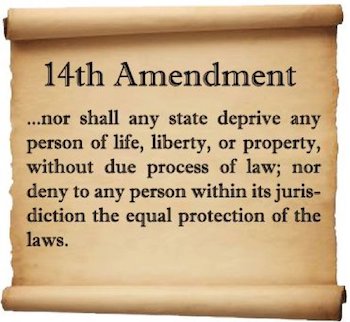
The plaintiff is arguing that the Board of Education violated the “equal protection clause” in the 14th Amendment. As the Amendment states, “All persons born or naturalized in the United States and subject to the jurisdiction thereof, are citizens of the United States and of the State wherein they reside. No State shall make or enforce any law which shall abridge the privileges or immunities of citizens of the United States; nor shall any State deprive any person of life, liberty, or property, without due process of law; nor deny to any person within its jurisdiction the equal protection of the laws.”
The “equal protection clause’s” purpose was intended to stop these state governments from discriminating against African Americans, but here we are fighting it today. While the plaintiff is arguing under the “equal protection clause,” I’d like to expand more on the 14th Amendment. As the Amendment states, “All persons born or naturalized in the United States and subject to the jurisdiction thereof, are citizens of the United States and of the State wherein they reside. No State shall make or enforce any law which shall abridge the privileges or immunities of citizens of the United States; nor shall any State deprive any person of life, liberty, or property, without due process of law; nor deny to any person within its jurisdiction the equal protection of the laws.”
The “equal protection clause’s” purpose was intended to stop these state governments from discriminating against African Americans, but here we are fighting it today. This equal protection means that any person in similar conditions would be treated the same. Any person, regardless of race, shall not be denied equal protection of laws. The constitution does not specifically state that education is a fundamental right, but the 14th amendment requires equal protection when state laws are implemented. Therefore, a state government cannot create a public school system that is discriminatory or does not allow certain groups to be enrolled. The Topeka Board of Education is violating this federal protection, as the public school system cannot refuse enrollment to any race under the 14th Amendment.
| Liberty |
Following the Civil War, the nation was forced to essentially rebuild itself and society. Countless slaves had now been freed and the union was made one again. While the northerners and Republicans attempted to helps the former slaves adapt to new life, many white southerners resented that idea. The federal government developed several plans, such as the Freedman's Bureau. However, Reconstruction is now known as one of the most tumultuous times in American history.
After Lincoln's assassination, President Johnson was sworn in as president. While Johnson did not like the white and rich plantation owners, he forced these plantation owners to beg for forgiveness in order to get their land back. This seems to be Johnson attempting to boost his ego and feel above all of the people. However, he tragically hurt the former slaves more than anyone. The land that these former confederates would have received would have been the same land that the former slaves would have received through the Freedman's Bureau. The plan to help compensate these former slaves was to give them "40 acres and a mule." Unfortunately, this did not happen. Johnson ended up giving the land back to the former confederates and shut down any momentum for these freedmen.
| Reconstruction |
However, the 14th and 15th Amendments gave many more rights to the former slaves, along with many other Americans. This didn't stop southerners from trying to recreate slavery. Labor contracts began to appear and laws that allowed segregation became more often. While these laws do not specifically say anything about race, companies and businesses were able to abuse this power to keep the African American population in subordination. Violence and hatred towards African Americans began to rise, along with the formation of the Klu Klux Klan.
While Reconstruction did have its positives, such as the freedom of slaves and Amendments, it was the opportunity that could have changed the lives of millions and the United States. Reconstruction's attempt to help African Americans fueled more racism and oppression, and would finally make major strides only decades later.
Other source-Reconstruction Video from Class
The construction of the transcontinental railroad was perhaps one of the most ambitious projects following the American industrial revolution. In order for the railroad to connect the nation, it needed to go through American controlled areas, such as the Nebraska Territory and the Louisiana Purchase. According to the presentations given, “Senator Frederick Douglass” wanted the these western territories to become two territories, and eventually states. I believe the presenter confused the Abolitionist Frederick Douglass with Democratic Senator Stephen A. Douglass, who actually drafted the Kansas-Nebraska Act.
| Bleeding Kansas |
The act proposed that through popular sovereignty, the people in these territories would decide if their territories would allow slavery. This resulted in the mass movement of pro and anti-slavery moving to the territories. Due to Nebraska being a more northern state, the state deciding to be anti-slavery was very likely. However, Kansas was more southern and became a hotspot for the controversy around the act. As both supporters and opponents of slavery poured into the state, tensions began to rise. Violence and brutality began in the state, which is now known as “Bleeding Kansas.”
The Kansas-Nebraska Act was one of the last key events that sparked the Civil War. While the issue between the north and south was more heated than ever, the issue of the western states and slavery had not been in focus since the Missouri Compromise of 1870. If slavery was allowed in these states, more slave states could have arisen. The North desperately wanted to avoid this while the slave states tried to protect their ways, ultimately leading to the Civil War.
Throughout history, slave owners have always treated their slaves just as they would their own property, considering that they are property. From ancient civilizations to the present, slaves have been treated by their owners as they wish, with certain regulations. Since the institution of slavery has been a part of human history, essentially as long as civilization has been around, we should look to the past to fully understand how a previous civilization treated and punished its slaves.
| John Mann |
According to Roman law, “Slaves are in the power of their owners. This power is derived from the common law of nations, for we can see that among all nations alike owners have the power of life and death over their slaves, and whatever is acquired by a slave is acquired on behalf of his owner.” So if a slave tried to escape from their owner in ancient Rome, would it be justified if the owner shot the slave with a bow and arrow? It is mentioned later in Roman law that, “ neither Roman citizens nor any other people who are subject to the sovereignty of the Roman People have the right to treat their slaves with excessive and unreasonable brutality.” It goes on to state, “Excessively harsh treatment on the part of owners is also limited by a Constitution of the same Emperor; for when certain provincial governors asked him for a ruling regarding slaves who had taken refuge at the temples of gods or statues of emperors, he declared that owners were to be forced to sell their slaves if the cruelty of their behaviour appeared to be unbearable.”
| Slavery in Ancient Rome |
When we examine this, the first selection of text declares that slaves are under direct control of their owner, including life and death. However, the next phrase is inserted to protect the slaves from excessive and unreasonable brutality. The last selection of texts essentially prevents abusive owners from holding possession of their slaves. So now we go back to the question: According to this selection of texts, would it be justified if an owner shot his runaway slave with a bow and arrow? While one could argue that shooting a runaway slave is excessive or unreasonable, you must also view the situation as a whole. For the Mann case, it is stated that Lydia tried to escape a minor punishment, which implies that the slave had done something wrong. Punishing a slave for doing something wrong is a very common practice in the South, and is often justified. If we look back on the laws of ancient Rome, this would not be considered excessive or unjustified, which means that Mann would have acted within his given power if he was in ancient Rome.
| Runaway Slave |
"Hello all. Before I begin, I’d like to give you a brief introduction of myself. I am Andrew Jackson, former president, war veteran, and founder of the Democratic Party. I am from both North and South Carolina, as I consider them both to be my home. I left home to fight in the Revolutionary War when I was thirteen and became a major general in the War of 1812. After becoming a Senator, I ran for president in 1828 and beat Adams in a landslide. I am known as the “people’s president,” and favor a strong central government while also fighting corruption. While I am mostly known for being a president of the United States, I am also a lawyer, which obviously makes me very familiar with the law. During my time of practice as a lawyer, I was able to earn a reasonable amount of money. With this money, I purchased a large plot of land which I have named “The Hermitage.” I use this farm to grow cotton for steady income. On this farm I have a relatively large number of slaves, 150, that I have spent much money on. 
For us in the South, slavery is a way of life. Slavery has been a generational institution in the South that has allowed prosperity and wealth to accumulate in these great states. These plantations have been built around the practice and if slavery is abolished, the American economy will take a severe blow. The practice is used all over the world, and if we stop it, there will surely be a financial scare in the country, which is the last thing we need as we recover from two wars that I fought in firsthand. Slavery allows the South to be so prosperous, because without it we would simply not have enough workers. The free labor allows plantation owners to increase production, which means more distribution for these products.
Without this boost, there will be shortages of various raw materials and goods such cotton, tobacco, and soybeans. The abolishment of slavery would lead to a drastic loss of production for farmers who would now have to pay for work. I only have roughly 150 slaves, and having to pay workers would change my entire business. There are plantation owners that own countless more slaves than me, and they would be hit incredibly hard. If there is a slowing or complete halt in the production of these raw materials, industries could be severely damaged from the effects of abolishment. The clothing industry would be short with cotton, cigarette and cigar companies would hurt greatly from this. All the good and honest people of this nation would be hit incredibly hard, while the rich and influential manufacturers grow in the north. The great common white man of this country will suffer while the blacks prosper and take from the whites. The inferior blacks and “red children” have already been a plague to this nation when they step out of line. This is why I relocated thousands of these “red” savages so the white man could have more land in which to prosper. 
Trail of Tears
Abolishing slavery would also mean that the money used to buy slaves would be wasted. Slaves are an investment, the money would be wasted on buying these farm tools. Since we are living in a new and growing country, this would be incredibly hurtful to plantation owners that are trying to make an honest living. Without slavery, the economy in the South simply cannot function. Any man that opposes slavery and our way of life must “atone for this wicked attempt with their lives.” “I can with truth say mine is a situation of dignified slavery.”
The First Amendment has been the corner stone for the development of civil rights in the United States. Although it has not been an easy end...