Tuesday, December 14, 2021

Final Blog for FYS 1000 "Big Question"

The First Amendment has been the corner stone for the development of civil rights in the United States. Although it has not been an easy endeavor, the several people and events have risen to the occasion of changing history, for better or worse. In this final blog post for FYS 1000, I'm going to talk about two important events, led by MLK, that shaped the United States due to the freedoms given by the first Amendment.

MLK Jr. during the Bus Boycott


When it comes to the discussion of the progress made in civil rights in the United States, one simply cannot exclude Martin Luther King Jr. As perhaps the most prominent leader within the civil rights movement, MLK spearheaded the segregation in the United States, while yet promoting peaceful protests. 


The minister led the Montgomery bus boycott of 1955, after Rosa Parks was arrested for refusing to move to the back of the bus. The boycott was one of the first main displays of protest that brought MLK to the front of the fight for civil rights. Not only did this boycott popularize King, but it showed that peaceful protests had huge potential in the public eye. The national media was drawn to the demonstration, as a protest of this scale had never been mainstream as the bus boycott. After the boycott, which lasted 385 days, the District Court ruled that there can no longer be racial discrimination on the public Montgomery busses. 

The March on Washington


Perhaps the most important event of the civil rights movement was the March on Washington in 1963. Along with other prominent leaders in the movement, King led an absolutely enormous peaceful protest in Washington, DC. Approximately 250,000 people joined the protest This protest was the greatest exhibition of the cry for equality from African Americans and other groups. Not only were issues of segregation and discrimination addressed, but other labor related issues. 


While the main focus of the march was for equality, Martin Luther King Jr. spoke his iconic "I Have a Dream" speech, which is a phrase that can be identified by nearly everyone today. King optimistically spoke about his goal, which is to see a truly united America. Whether it was between race or religion, King wanted unity and peace in the country. 


There is no doubt that King has gone down as one of the most important and influential leaders of the 20th century. King spoke wisdom and promoted peaceful protests and equality. Due to the first amendment, King, along with others, changed the United States forever. 


Without the first amendment, none of this would have been possible. There would be no Martin Luther King Jr. in our history books.


The progression of civil rights in the United States grew upon the freedoms that were left by our Founding Fathers. Without the first amendment, there would not have been legal protests, speeches, or promotion for civil rights. The March on Washington was one of the largest demonstrations possible through the first amendment at the time. Not only was this protected as a freedom of assembly, but King and all other speakers were protected through freedom of speech.

Martin Luther King Jr.


Without nearly all of the freedoms from the first amendment, change would not have been possible. King would not have gotten the media attention that he did through the boycotts and would not have been able to make his great speeches without freedom of speech. The other peaceful protests at the time, like the Library Sit-in would have been illegal but, luckily, we are blessed with the first amendment which allows change in the country. Our system simply would not work without it. 

Monday, December 13, 2021

What I learned from Trial #4

For the fourth mock trial of our class, the other groups presented their cases from the Regents v. Bakke case of 1978. The case revolves around the rejection of Bakke from the university's medical school twice, to which Bakke argued violated the Fourteenth Amendment and Civil Rights Act. Bakke sued the school due to being denied acceptance twice, suggesting that affirmative action was the main factor behind his denial, as the school had racial "quotas" to be accepted. He believed that he was not accepted due to his skin color, as a spot at the school that easily could have been for him was saved for another due to race.


The Supreme Court took the case and made a 5-4 decision. The decision stated that race can be considered a factor for school applications, but having a racial quota violated the Equal Protection Clause of the Fourteenth Amendment. 


Regents v. Bakke


The college 100 spots for their enrollment into their medical school, and 16 of these spots were reserved for minorities. The Supreme Court ruled that these reserved spots were in violation of the Equal Protection Clause. 

Although Bakke believed this was the main reason he was rejected, he was in his 30's, which would have been far older than the average age group. Being several years behind and older may have put him at a disadvantage behind his classmates and skills. His rejection was based on many factors, including merit, age, race, and his interview. 

Sunday, December 12, 2021

EOTO 4

 
After the disbanding of the second Klan in  the 40’s due to declining membership and an IRS tax liability, the Klan continued through smaller, unofficial chapters. While the Klan was kept alive through smaller groups, some groups grew and had more influence than others. These smaller groups gained more traction and growth during the Civil Rights Movement, while still independent of each other. This era of the Klan was filled with acts of terror and hatred against African Americans, supporters, and important figures of the Civil Rights Movement. 


These acts of terror and hatred included countless instances of physical violence, arson, assassinations, lynchings, bombings, and more. One of the worst displays of the Klan’s violence was the 16th Street Baptist Church Bombing, which killed 4 African American girls and injured 22. The Klan instigated so many bombings during the 1950’s in Birmingham that the city was (unfortunately) nicknamed “Bombingham.”


While the Klan had a brief resurgence in the 50’s and 60’s, it is estimated that the peak of the membership in the 3rd Klan was in 1965 with approximately forty thousand members. Since then, membership has fluctuated but has continued to decline, with the current membership estimated to be under three thousand. 


After the Civil Rights Era, the dying Klan continued to commit acts of hatred and terror on innocent people, including murders, shootings, lynchings, and bombings. Fortunately, the decline in the membership of the Klan has resulted in much fewer instances of violence compared to the Civil Rights Era. 

David Duke

Today, the modern Klan is made of many independent chapters. However, it is still alive. Certain chapters of the Klan have aligned with Neo-nazi groups as there has been an increase in the number of hate groups in the last few years. 
The Klan has even had well known leaders hold office. David Duke, formally a Grand Wizard of the Knights of the KKK, not only ran for president in 1988, but had a successful campaign for the Louisiana House.


To end this segment, I recommend the movie  BlacKkKlansman to anyone who has not seen it. BlacKkKlansman is based on the true story of Ron Stallworth who, as black police officer in the Colorado Springs Department, infiltrates the Klan led by David Duke in the 70’s.
Ron Stallworth

"White Like Me" Blog

Tim Wise, an activist and writer, wrote a book reflecting and examining his past as a white man. In his book, White Like Me: Reflections on Race from a Privileged Son, Wise discussed racism from a self-aware perspective. After using crowdfunding through Kickstarter, Tim Wise was able to turn his book into a documentary. At the time of filming, the United States had already made huge strides in racial equality. The current president during the filming of the documentary was Barrack Obama, an African American. As the country seemed to be very hopeful and ahead of racism, Wise disagrees.


Wise begins the documentary by going to his childhood, where states that he attended a mostly African American primary school, where he became familiar and friends with people not of his race. Due to his different upbringing compared to his white peers, his time at the primary school gave him a different perspective and fueled his drive for activism. At college, he became heavily involved with activism, including rallying against apartheid in South Africa. While Wise was fighting for equality in another country, he states that he was blind to the privileges that he had been adjusted to throughout his live in his town. 


He lived in New Orleans at the time, where a black man was beaten to death in custody. Although he did not have much of a reaction to this event, it changed when a young African American student asked him what he'd done for his own city. He realized that he had done nothing. He was fighting racism across seas but not in his own city. After this event, Tim Wise decided to become more of an activist than he ever had, leading up to writing a book and becoming a public advocate. 


In the documentary, Wise confronts issues of white privileges and racism. Wise suggested in the documentary that instead of asking "What it's like to be black," one should ask "What's it like to be white?" Looking back on the history of the United States,  many instances and foundations of the county have been based "purely on skin color." There have been many laws and decisions that have been discriminatory towards African Americans and many that have benefited white people. Tim Wise hopes the viewer will think about the influence of their skin color on their lives, and to look at it from another perspective. 


The documentary definitely made me think about how being white has affected my life. I've learned a lot in this class about the fight for equality that I had never known. For schooling, I went to a private K-12 school, which I learned was created during the 50s-60s due to the White Flight. Now at HPU, which is a very costly school, I still see many white people. I'm glad I watched that documentary, as it opened my eyes up to ideas I have never considered before. 
Brunswick Academy


EOTO 3 Reaction

During the Civil Rights Era of the United States, the country was divided again between the supports and opponents of the movement. As the nation was approaching a century since the end of the civil war, the remnants of the old south were still present. While the northern states were the most progressive, many areas in the southern states were still stuck in time. The civil rights movement had a lot of opposition, especially from the Ku Klux Klan. Throughout the extent of the American Civil Rights Era, the Klan and other white supremacy groups committed horrific events against the African American community and its supporters. 


One of the worst displays of violence by the Klan was the 16th Street Baptist Street Church Bombing in 1963. In Birmingham, Alabama on September 15th, four members of the Ku Klux Klan detonated a bomb that had been planted under the steps of the church. The bomb detonated around 11 A.M., killing 4 young African American girls and injuring 22 more. 


Aftermath of the Bombing


The four Klan members involved in the attack planted 19 sticks of dynamite, rigged to explode due to a timing device, under the east steps of the church. Three out of the four men behind the attack were not prosecuted until 1977, and none were imprisoned until 2001 and 2002. One of the four men, Herman Cash, died before he was convicted.

Of course, this tragic event exerted mass grief among supporters of the Civil Rights movement. Martin Luther King Jr. described the tragedy as "one of the most viscous and tragic crimes perpetrated against humanity" While the 1964 Civil Rights Act would be passed only the next year, this chaotic era of United States history unfortunately claimed many lives. 


Martin Luther King Jr.

EOTO # 2

Ratified on July 9th 1868, the 14th Amendment has become one of the most important Amendments due to its influence on the development of the US. The Amendment has had a large role in the development of equality for African Americans  in America. Some of the most important civil rights events have been made under the 14th Amendment. 

Following the 13th Amendment, which abolished slavery in the newly reformed United States, there needed to be an additional amendment that focused on establishing and protecting the rights of the new citizens. Different plans and proposals led up to the 14th Amendment, spanning from solidifying rights for African Americans to issues still present after the Civil War. 


One of these was the Civil Rights Act of 1866, which stated that all people born in the United States were entitled to be citizens no matter no matter race or color. President Johnson vetoed the bill, but Congress overrode his veto. This is the first time in United States History that Congress overrode a presidential veto.   


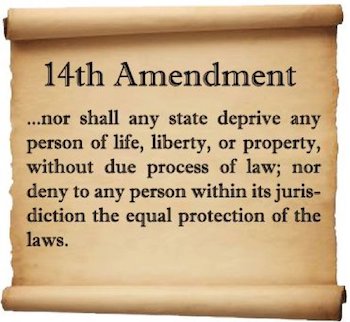
14th Amendment

The different legislative proposals that were being pushed at the time all came together through Representative Thaddeus Stevens. The proposal written by Stevens included some of the most pertinent issues at hand, the main parts being  civil rights for African Americans, ceasing existing Confederate debt, and baring former Confederate officials from running for office. This plan was submitted to the states for ratification in June of 1866, and was passed on July 9th, 1868 the three fifths majority requirement was completed.


The primary objective of the amendment was to solidify civil rights and freedoms in the United States Constitution. Along with introducing new laws, the amendment built upon the 5th Amendment. While the 5th Amendment established Due Process, the 14th Amendment extended the coverage of due process to states as well. This is the first Amendment that limits state action


The amendment includes  3 main clauses: Equal Protection, Due Process, and Privileges or Immunities. This reversed previous decisions and laws, such as the Dred Scott Decision,  that forbid slaves and even freedmen from becoming US citizens. 

Citizenship for former Slaves


In order to ensure political change in the former confederate states, the 14th Amendment forced the removal and re-election of all Confederate officials. Section 4 of the Amendment states that any debt in  aid to the confederacy was to be forgotten and any losses claimed from the release of slaves would be illegal. The final section of the Amendment states that Congress has the power to enforce the provisions made in the Amendment, although this is in other Amendments.


Source Used: https://www.history.com/topics/black-history/fourteenth-amendment


Monday, November 15, 2021

Brown v. Board of Education

    The plaintiff, Oliver Brown, has filed a class-action lawsuit against the Topeka Board of Education for denying his daughter entrance to the city’s all white public schools. The denial of Oliver Brown’s daughter, Linda Brown, to the city’s all white schools is a violation of the 14th Amendment. Specifically, this violates the “equal protection clause,” which was created to prevent instances like this from occurring. 

Hopeful child and guardian sit at outside the US Supreme Court Building after the decision.


After the civil war, the southern states began attempting and succeeding to pass racist and discriminatory laws against the newly freed slaves in this country. These slaves were real people, and now that the war was over, these states were trying to take back control of their power over these people. This is why Congress took action to pass the 14th Amendment after the war. This amendment was passed to ensure these human beings basic rights. With these people now being citizens, they should be protected like a normal citizen of the United States. Unfortunately, we are still haunted by this country’s past, as we are still fighting the shadow of slavery today. However, we can change this nation forever if the court makes the right decision- the one that is backed by the Constitution. 


The plaintiff is arguing that the Board of Education violated the “equal protection clause” in the 14th Amendment. As the Amendment states, “All persons born or naturalized in the United States and subject to the jurisdiction thereof, are citizens of the United States and of the State wherein they reside. No State shall make or enforce any law which shall abridge the privileges or immunities of citizens of the United States; nor shall any State deprive any person of life, liberty, or property, without due process of law; nor deny to any person within its jurisdiction the equal protection of the laws.” 


The “equal protection clause’s” purpose was intended to stop these state governments from discriminating against African Americans, but here we are fighting it today. While the plaintiff is arguing under the “equal protection clause,” I’d like to expand more on the 14th Amendment.  As the Amendment states, “All persons born or naturalized in the United States and subject to the jurisdiction thereof, are citizens of the United States and of the State wherein they reside. No State shall make or enforce any law which shall abridge the privileges or immunities of citizens of the United States; nor shall any State deprive any person of life, liberty, or property, without due process of law; nor deny to any person within its jurisdiction the equal protection of the laws.” 


The “equal protection clause’s” purpose was intended to stop these state governments from discriminating against African Americans, but here we are fighting it today. This equal protection means that any person in similar conditions would be treated the same. Any person, regardless of race, shall not be denied equal protection of laws. The constitution does not specifically state that education is a fundamental right, but the 14th amendment requires equal protection when state laws are implemented. Therefore, a state government cannot create a public school system that is discriminatory or does not allow certain groups to be enrolled. The Topeka Board of Education is violating this federal protection, as the public school system cannot refuse enrollment to any race under the 14th Amendment. 

Liberty


Final Blog for FYS 1000 "Big Question"

The First Amendment has been the corner stone for the development of civil rights in the United States. Although it has not been an easy end...